Calculate drain pipe slope, pipe fall and total drop in seconds — automatically checked against IPC, UPC and NPC minimum slopes. Plan multi-segment runs, keep each job's notes and photos, and share a PDF report. Or lay your iPhone on the pipe and measure the grade directly.

 Scan with your iPhone camera to download
Built for plumbers, pipefitters, contractors and inspectors — and precise enough for the serious DIYer roughing in a bathroom.
Find slope, find drop, find the longest run, or work from invert elevations. Results in in/ft, mm/m, percent, ratio and degrees, with set-out numbers for your level, string line and pipe laser.
Select IPC, UPC or NPC and the app flags any slope below the minimum for your pipe size, names the clause it comes from, and covers the UPC's 4"+ AHJ exception.
Digital torpedo level mode: calibrate in two steps, lay the phone along the pipe, watch the reading turn green at your target slope, then lock it into the calculator.
Basements, crawl spaces, new builds with no service — every feature works with zero signal. No account, no ads, no tracking.
Chain up to 15 segments into a run with drop and invert at every station. Keep each job's calculations, runs, notes and photos together, and share one PDF job report.
1½" through 15" (DN 40–DN 375), with slope presets from 1/16"/ft to 1"/ft or 1:40 to 1:200, a slider for any grade, and the whole app in English or French.
Swipe through the app — from code selection to slope measurement.


On iPad, the code, pipe size and measurements sit next to the verdict, the numbers and the diagram, so you see every change as you type — in portrait or landscape.


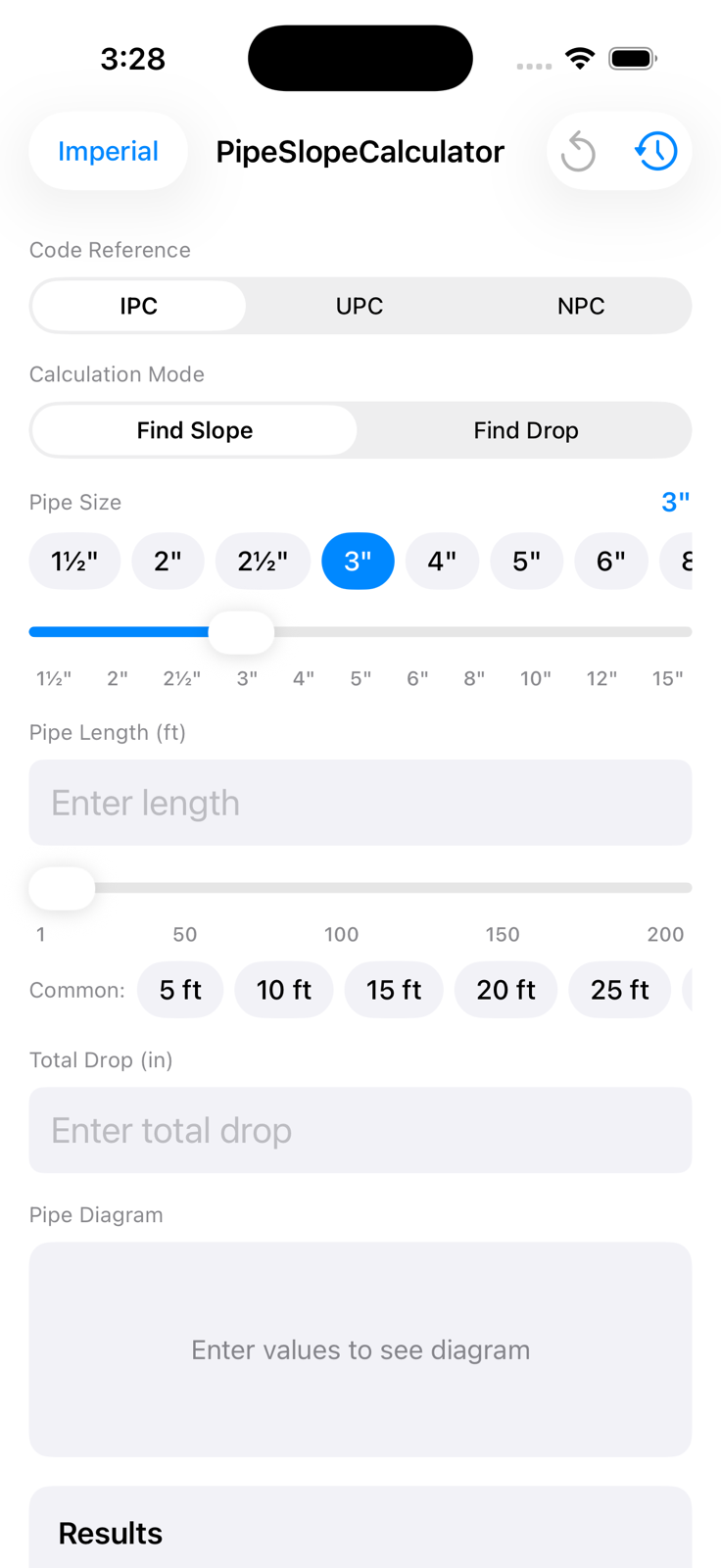
Choose IPC, UPC or NPC and tap your pipe size (1½"–15"). The app instantly knows the minimum slope that applies.
Type the run length and either the drop you have or the slope you want — or capture the live slope by laying your iPhone on the pipe.
Total drop, slope in in/ft or mm/m, percent grade, ratio and angle, the code clause, and a clear warning if you're below the minimum. Save it to a job or share a PDF report.
The numbers the app checks for you, straight from the three major North American plumbing codes:
| Pipe size | IPC 2024 (§704.1) | UPC 2024 | NPC 2020 (Canada) |
|---|---|---|---|
| 1½" – 2½" | ¼"/ft (2.08%) | ¼"/ft (2%) | 1:50 · ≈¼"/ft (2%) |
| 3" | ⅛"/ft (1.04%) | ¼"/ft (2%) | 1:50 · ≈¼"/ft (2%) |
| 4" – 6" | ⅛"/ft (1.04%) | ¼"/ft (2%)* | 1:100 · ≈⅛"/ft (1%) |
| 8" – 15" | 1/16"/ft (0.52%) | ¼"/ft (2%)* | 1:100 · ≈⅛"/ft (1%) |
* UPC: pipe 4" and larger may be approved at ⅛"/ft (1%) by the Authority Having Jurisdiction where ¼"/ft is impractical. Reference only — always verify with your local AHJ. See the full IPC vs UPC vs NPC comparison.
Straight answers to the slope questions plumbers and DIYers actually search for — each with the exact code numbers and a worked example.
IPC, UPC and NPC minimums for every pipe size from 1½" to 15", in one chart.
Read the guide →Fall per foot by pipe size, plus a total-fall chart for runs from 10 to 100 feet.
Read the guide →⅛" or ¼" per foot? What each code requires for 4" main lines — and why it matters.
Read the guide →Where the IPC and the UPC/NPC give different answers for toilet drains. What yours actually needs.
Read the guide →The formula, percent-grade conversion table, and two worked examples.
Read the guide →Can a drain be too steep? What the codes say and the ¼"–½" field rule.
Read the guide →Drop chart from 1 to 100 feet, plus conversions to percent, mm/m and degrees.
Read the guide →Turn your phone into a digital torpedo level and capture the reading into the calculator.
Read the guide →Side-by-side comparison of the three major codes, including the UPC's AHJ exception.
Read the guide →1:50 vs 1:100, mm per metre, DN pipe sizes and how to convert to percent.
Read the guide →Under the International Plumbing Code (IPC), horizontal drain pipes 2½ inches and smaller need a minimum slope of ¼ inch per foot, pipes 3 to 6 inches need ⅛ inch per foot, and pipes 8 inches and larger need 1/16 inch per foot. The UPC requires ¼ inch per foot for all sizes unless the local authority approves flatter slope on 4-inch-plus pipe. Always confirm with your local code. Learn more →
Under the IPC, a sewer line needs ¼ inch of fall per foot up to 2½-inch pipe and ⅛ inch per foot for 3- to 6-inch pipe. Canada's NPC asks 1:50 (about ¼ inch per foot) up to 3 inches and 1:100 (about ⅛ inch) for 4 inches and up, and the UPC ¼ inch per foot for every size. A 50-foot 4-inch sewer at ⅛ inch per foot drops 6.25 inches in total. Learn more →
A 4-inch sewer or drain pipe needs a minimum slope of ⅛ inch per foot (about 1%) under the IPC and NPC. The UPC requires ¼ inch per foot (2%) unless the Authority Having Jurisdiction approves ⅛ inch per foot. Learn more →
Under the IPC, a 3-inch drain needs at least ⅛ inch per foot of slope. The UPC requires ¼ inch per foot, and Canada's NPC 1:50 (about ¼ inch per foot). Many plumbers run 3-inch toilet drains at ¼ inch per foot regardless, for a self-cleaning safety margin. Learn more →
Divide the total drop by the pipe length. For slope in inches per foot, divide the drop in inches by the run in feet. For percent grade, divide inches-per-foot by 12 and multiply by 100 — so ¼ inch per foot equals about 2.08%. Learn more →
Percent grade is in/ft ÷ 12 × 100, the ratio is 1 : (12 ÷ in/ft), and the angle is the arctangent of in/ft ÷ 12. So ¼ inch per foot is 2.08%, 1:48 and 1.19°, and ⅛ inch per foot is 1.04%, 1:96 and 0.60°. In metric, 20.8 mm/m is the same 2.08%. Pipe Slope Calculator reads and shows all five units, so you can type 1:50, 2% or 1.2° straight into the slope field. Learn more →
Divide the fall you have by the slope you need. With 6 inches of fall at ¼ inch per foot, the longest run is 24 feet; at ⅛ inch per foot it is 48 feet. Pipe Slope Calculator's Find Run mode does this for you, and when the slope is below the minimum for your pipe it names the smallest larger pipe that would meet code at that slope.
End invert = start invert − drop, and drop = length × slope. A 60-foot run at ¼ inch per foot drops 15 inches (1.25 ft), so a 100.00 ft start invert ends at 98.75 ft. In Elevations mode, Pipe Slope Calculator also compares the end invert with the sewer main's invert and warns when the connection sits too low for gravity, which may call for a sewage ejector.
Split the run into straight segments. For each one, drop = length × slope, and each station's invert is the previous invert minus that drop. Pipe Slope Calculator handles up to 15 segments, lists the distance, drop and invert at every station, and flags any segment below the code minimum. Example: from a 100.00 ft start invert, 20 ft at ¼"/ft, 25 ft at ⅛"/ft and 15 ft at ¼"/ft drop 11⅞ inches in total and end at 99.01 ft.
Multiply the slope by the level's length in feet: for ¼ inch per foot, a 4-foot level needs a 1-inch block under its downhill end and a 2-foot level needs ½ inch. In metric, a 1200 mm level at 2.08% (20.8 mm/m) needs a 25 mm block. Pipe Slope Calculator's set-out numbers also give the fall over a 10-foot string line (2½ inches at ¼ inch per foot) and the grade to dial into a pipe laser (−2.08%).
Codes set minimum slopes, not general maximums, and slopes of 45 degrees or steeper are treated as vertical piping. A widely used field guideline keeps gravity drains carrying solids between ¼ and ½ inch per foot, because very steep, shallow-graded runs can let liquids outrun solids. Some local authorities do publish maximum-pitch rules, so check your jurisdiction. Learn more →
At ¼ inch per foot, a 20-foot run drops 5 inches in total. The formula is run in feet × 0.25 inches — for example 10 ft drops 2.5 inches and 40 ft drops 10 inches. Learn more →
Yes. Pipe Slope Calculator uses the device's tilt sensor as a digital torpedo level. Calibrate it in two steps on any flat surface, lay the phone on its edge along the pipe, and read the live slope, which way the pipe falls, and whether you have hit your target; lock the reading once it is steady. Sensor readings are approximate (±1–2°, about ±0.2–0.4 in/ft), so verify with a calibrated level before making code-compliance decisions. Learn more →
The IPC scales minimum slope with pipe size (¼ in/ft up to 2½ inches, ⅛ in/ft for 3–6 inches, 1/16 in/ft for 8 inches and up). The UPC requires ¼ in/ft for all sizes, with a possible ⅛ in/ft exception for 4-inch-plus pipe where the local authority approves. Canada's NPC requires 1:50 (about ¼ in/ft) up to 3 inches and 1:100 (about ⅛ in/ft) for larger pipe. Learn more →
A 1:50 gradient means 1 unit of fall per 50 units of run — 20 mm of fall per metre, or a 2% grade. A 1:100 gradient is 10 mm per metre, or 1%. Multiply the run length by the gradient to get total fall: 8 m at 1:50 falls 160 mm. Learn more →
Yes. A job keeps one site's calculations, runs, address, permit number, notes and photos together and shares them as one PDF: a cover page, a page for each calculation and run, then the photos. Any single result can also be shared as a one-page report, as a PDF, an image or text. Everything stays on your device until you share it.
Yes. Since version 2.0 the app runs on iPhone and iPad (iOS and iPadOS 17 or later), in portrait or landscape, and on iPad the inputs sit beside the results. One purchase covers both devices. The whole app is available in English and French (Canada), where the National Plumbing Code appears as the CNP.
Yes — the app works 100% offline. Every calculation, code check, slope measurement, job and photo stays on the device, so it works in basements, crawl spaces and remote job sites with no signal. It collects zero personal data and contains no ads or tracking.
Pipe Slope Calculator is a one-time purchase of US$2.99 on the App Store. There is no subscription, no ads, no account and no in-app purchases — you pay once and own it, on iPhone and iPad.
Get the right slope, fall and drop — code-checked — before you set the pipe.
Scan with your iPhone camera
US$2.99 one-time · iPhone & iPad · iOS 17+ · English & français